Introduce Yourself in 30 Seconds
“Tell me about yourself” is the most common opening in interviews, networking, college fairs, and the first day of any club. Most people ramble or freeze. This guide gives you a four-part formula, a worked example to copy, space to build your own, and a drill so it sounds natural when it counts.
Write it, cut it to thirty seconds, and practice it out loud until it sounds like you talking, not a resume.
Free, print-ready, no email required
 Preview
What’s inside
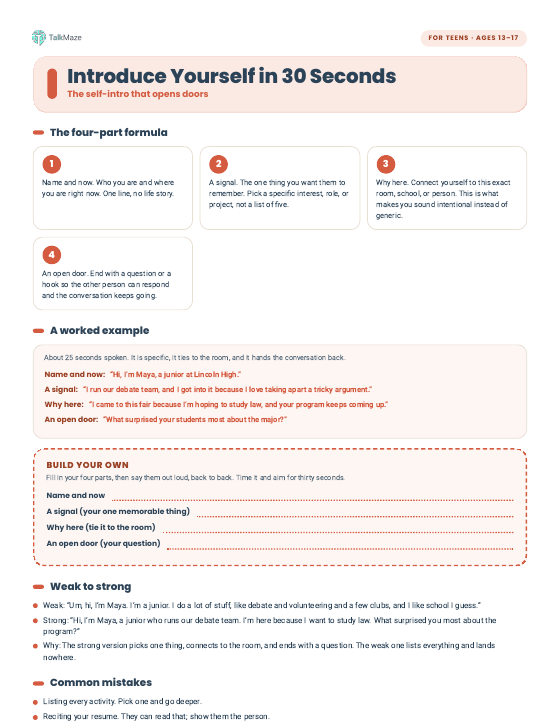
The four-part formula
- Name and now. Who you are and where you are right now. One line, no life story.
- A signal. The one thing you want them to remember. Pick a specific interest, role, or project, not a list of five.
- Why here. Connect yourself to this exact room, school, or person. This is what makes you sound intentional instead of generic.
- An open door. End with a question or a hook so the other person can respond and the conversation keeps going.
A worked example
About 25 seconds spoken. It is specific, it ties to the room, and it hands the conversation back.
- Name and now: “Hi, I’m Maya, a junior at Lincoln High.”
- A signal: “I run our debate team, and I got into it because I love taking apart a tricky argument.”
- Why here: “I came to this fair because I’m hoping to study law, and your program keeps coming up.”
- An open door: “What surprised your students most about the major?”
Build your own
Fill in your four parts, then say them out loud, back to back. Time it and aim for thirty seconds.
- Name and now
- A signal (your one memorable thing)
- Why here (tie it to the room)
- An open door (your question)
Weak to strong
- Weak: “Um, hi, I’m Maya. I’m a junior. I do a lot of stuff, like debate and volunteering and a few clubs, and I like school I guess.”
- Strong: “Hi, I’m Maya, a junior who runs our debate team. I’m here because I want to study law. What surprised you most about the program?”
- Why: The strong version picks one thing, connects to the room, and ends with a question. The weak one lists everything and lands nowhere.
Common mistakes
- Listing every activity. Pick one and go deeper.
- Reciting your resume. They can read that; show them the person.
- Talking for a full minute. Thirty seconds, then hand it back.
- Mumbling your name. It is the one thing they must catch.
- Memorizing it word for word until it sounds like a robot.
Say it well
- Slow down on your name and your one big thing.
- Look at the person, not the floor, and smile.
- A short pause before your question makes it land.
- Practice out loud, not in your head. It is a different skill.
Practice drill
- Write your four parts and say them out loud once.
- Record it on your phone and watch it back.
- Cut anything that is not one of the four parts.
- Try three different openings and keep the one that sounds like you.
- Do it for a friend or parent and ask what they remember afterward.
Ready when you are
Ready for a real coach?
Printables are a great start. A free 30-minute assessment pairs your child with a TalkMaze coach who works with them live and builds a plan. No credit card, no commitment.
Book my free assessmentFree assessment · no credit card · no commitment